
There are some attributes of God that we instinctively want near us. We want His goodness near us, His faithfulness beneath us, His power working for us. Justice is more complicated. We want it when we have been wronged—when the powerful exploit the weak, when corruption goes unpunished, when evil appears to prosper. Something in us rises at the thought that wickedness might finally win, that accounts might never be settled.
We become considerably less enthusiastic when the scales turn toward us.
That instinct reveals something true. We know enough about justice to appeal to it, but we are not ourselves just enough to welcome its perfect application. When our own lives are placed upon the scales, we introduce circumstances, intentions, mitigating factors, and mercy. The uncomfortable truth beneath all those qualifications: we do not naturally desire justice in the abstract. We desire a judgment favorable to us.
God does not.
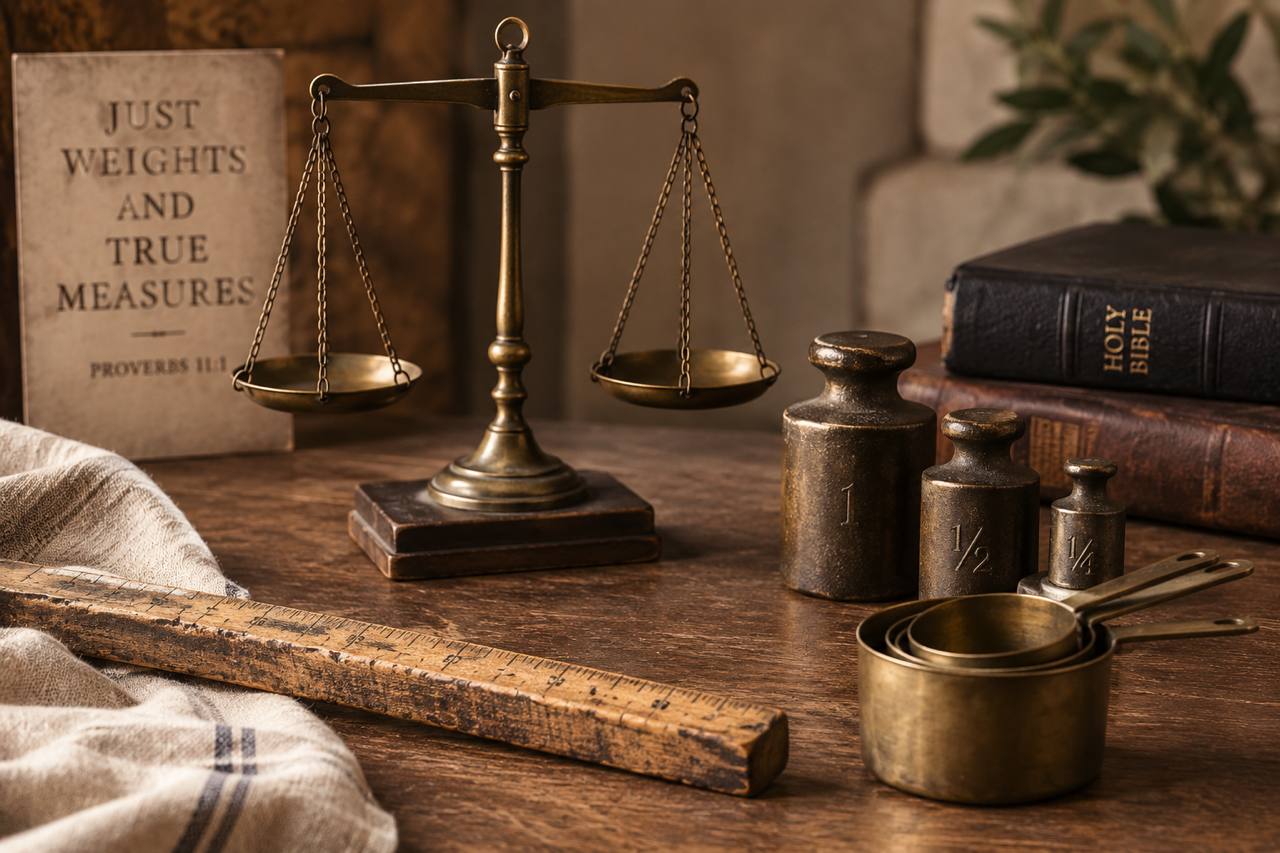
What Is the Justice of God?
“The Rock, his work is perfect, for all his ways are justice. A God of faithfulness and without iniquity, just and upright is he” (Deuteronomy 32:4).
That is a more frightening statement than it first appears. There is no crookedness in God. None. And because there is none in Him, there can be none in His judgments.
Scripture speaks of God’s righteousness and justice in overlapping ways. The Hebrew tsedeq (righteousness) and mishpat (justice) often appear together: “Righteousness and justice are the foundation of your throne” (Psalm 89:14). God’s righteousness concerns the perfect rectitude of His nature. His justice is that righteousness exercised in moral judgment. Because God is righteous, He invariably judges rightly—approving what ought to be approved, condemning what ought to be condemned, rendering according to truth, never bending judgment through ignorance, corruption, fear, or favoritism.
Justice is also distinct from wrath, though the two necessarily meet. Wrath is God’s holy anger and settled opposition toward evil. Justice concerns the rightness according to which evil is judged. In God, unlike in us, His wrath is always just, and His justice is never distorted by passion.
The Ground of Justice
Every moral claim quietly assumes a standard. When we say a board is crooked, we compare it to straightness. When we call a judgment unjust, we appeal to something beyond the judge. Moral judgments work similarly—when we say that a man ought not abuse a child, that a government should not murder the innocent, we mean more than personal preference. We are claiming there is a moral reality to which conduct must conform.
Where does that ought come from?
It cannot come from us. If individuals create morality, the murderer and victim simply have conflicting preferences. Society cannot be the final source either—societies themselves become unjust. Slavery doesn’t become righteous because a civilization legalizes it. And if power defines what is right, we haven’t explained justice at all. We’ve merely renamed victory.
Every genuine ought therefore points beyond the creature.
Christianity does not solve this by placing an abstract law above God, as though righteousness existed somewhere outside Him as a standard He must meet. But if justice were simply whatever an arbitrary divine will happened to command, calling God just would tell us almost nothing—cruelty could become justice tomorrow if God decided to call it that.
Scripture gives us neither extreme. Justice is grounded in God’s own perfect nature. “The LORD is righteous in all his ways” (Psalm 145:17). “The LORD is righteous; he loves righteous deeds” (Psalm 11:7). God is not measured by the straight line. He is why there is a straight line.
This means God cannot be slightly unjust. We have almost no analogy for it. Human beings can be generally fair while still rendering a bad decision in a moment of weakness or prejudice. We speak of better and worse systems of justice because human justice exists on a spectrum. God does not inhabit the good end of that spectrum. One unjust judgment—one innocent person knowingly condemned, one fact overlooked, one judgment distorted by partiality—would require God to cease being the God Scripture reveals. “The judgments of the LORD are true, and righteous altogether” (Psalm 19:9). The scales do not tremble in His hand.
The Judge Who Sees Everything
The traditional image of justice is blindfolded. Lady Justice holds her scales while her covered eyes symbolize impartiality—she must not know whether the person before her is rich or poor, friend or enemy. Human justice sometimes protects itself by refusing to see what might improperly influence judgment.
God’s justice is impartial for the opposite reason. He sees everything.
“No creature is hidden from his sight, but all are naked and exposed to the eyes of him to whom we must give account” (Hebrews 4:13). God knows the deed and the intention. He knows what was done publicly and what was concealed. He knows the outward act of generosity and the vanity secretly feeding upon the applause. He knows what warnings we ignored and what motives we have successfully hidden even from ourselves.
This omniscience makes His justice terrifyingly exact. Scripture speaks of degrees of accountability: Jesus says it will be “more bearable on the day of judgment for the land of Sodom and Gomorrah” than for towns that witnessed His works and rejected Him (Matthew 10:15). God “will render to each one according to his works” (Romans 2:6). Divine judgment is precise without being crude.
And God shows no partiality. He cannot be bought, intimidated, or pressured by a crowd. He does not adjust His verdict because the defendant is important, and He does not condemn someone merely because condemnation would satisfy public outrage. He has no constituency to appease and no election to survive. There is something wonderfully clean about divine justice—and something terrifying about its cleanness—because every technique by which human beings evade human judgment is useless before Him.
When Justice Seems Absent
The world frequently does not look just. The wicked prosper. The righteous suffer. Abusers die peacefully in old age. Faithful people are buried young.
Psalm 73 is written from inside this scandal. Asaph nearly loses his footing when he sees “the prosperity of the wicked” (Psalm 73:3). For a moment he concludes, “All in vain have I kept my heart clean” (Psalm 73:13). That is the pressure injustice places on faith—if righteousness and wickedness receive the same end, righteousness begins to look foolish.
But Scripture does not solve this by pretending the observation is false. Habakkuk asks why God tolerates wrong while “justice goes forth perverted” (Habakkuk 1:4). The martyrs beneath the altar cry, “O Sovereign Lord, holy and true, how long before you will judge and avenge our blood?” (Revelation 6:10). They do not ask whether God will judge. They ask how long.
The apparent absence of justice in history becomes an argument for judgment beyond history. Ecclesiastes sees wickedness where justice ought to be and concludes, “God will judge the righteous and the wicked” (Ecclesiastes 3:17). Delay is not acquittal. Justice has an appointment.
The Great Problem: How Can a Just God Forgive?
Here is where the doctrine of divine justice moves from abstract to urgent.
We usually approach salvation by asking how a loving God could condemn sinners. Paul approaches the gospel from the opposite direction: How can a just God forgive them?
Imagine a judge before whom overwhelming evidence establishes a murderer’s guilt. Witnesses testify. DNA confirms. Video records it. The defendant confesses. Then the judge smiles and says, “I am merciful. You may go.”
We would demand his removal. Mercy that simply ignores justice is corruption. Scripture itself says so: “He who justifies the wicked and he who condemns the righteous are both alike an abomination to the LORD” (Proverbs 17:15).
Read that carefully. God calls the justification of the wicked an abomination. Then Paul announces that God “justifies the ungodly” (Romans 4:5). There is the crisis at the heart of the gospel. How can God do what He Himself declares abominable—and remain righteous?
The Cross: Just and Justifier
Paul does not leave the tension unresolved. God put Christ forward “as a propitiation by his blood, to be received by faith.” And here is the key: “This was to show God’s righteousness, because in his divine forbearance he had passed over former sins” (Romans 3:25).
The cross demonstrates more than God’s love for sinners. It vindicates His righteousness in having forgiven them.
Romans 3:26 states the purpose with extraordinary precision: the cross occurred “so that he might be just and the justifier of the one who has faith in Jesus.” God remains just while He justifies. His attributes are not competing departments negotiating a compromise. Mercy does not persuade justice to leave the courtroom. Justice receives everything justice requires—and the sinner receives mercy.
The explanation is substitution.
“He was pierced for our transgressions; he was crushed for our iniquities” (Isaiah 53:5). “The LORD has laid on him the iniquity of us all” (Isaiah 53:6). God made Him “to be sin who knew no sin, so that in him we might become the righteousness of God” (2 Corinthians 5:21). Christ “suffered once for sins, the righteous for the unrighteous, that he might bring us to God” (1 Peter 3:18).
The cross is mercy for us because it is judgment upon Him. The guilt remains what it is. The judgment remains what it ought to be. Christ stands where His people should stand. And His final declaration carries the full weight of that reality: “It is finished” (John 19:30). Nothing remains unpaid.
Justification: More Than Forgiveness
The gospel does something equally staggering in the other direction. The guilt of the sinner is reckoned to Christ—and the righteousness of Christ is reckoned to the sinner.
This is justification, and justification is a courtroom word. God does not first transform the sinner into a sufficiently righteous person and then pronounce him righteous upon inspection of the improvement. He “justifies the ungodly” (Romans 4:5)—the verdict comes while the ground of righteousness remains entirely outside the sinner, in Christ.
This is bigger than forgiveness. Forgiveness alone would be enough to occupy eternity’s praises—every crime removed, every debt canceled, every accusation answered. But justification goes further. The sinner leaves the courtroom with a righteous standing before God he did not produce and cannot improve upon. God receives him according to the righteousness of His Son.
“For our sake he made him to be sin who knew no sin, so that in him we might become the righteousness of God” (2 Corinthians 5:21). Our guilt reckoned to Him. His righteousness reckoned to us. The verdict is judicial, but it is not imaginary. The scales remain straight in both directions.
This is why the Christian can say: “There is therefore now no condemnation for those who are in Christ Jesus” (Romans 8:1). Not eventually. Now. The verdict has already been rendered. Justice has already spoken.
He Pays or You Do
That makes unbelief far more serious than simply declining a religious offer. If Christ is the only righteous satisfaction for guilt, to reject Christ is to choose to stand before perfect justice without Him.
There is no third option. Either Christ bears the judgment or the sinner does.
Jesus gave a warning that sounds almost mundane until you understand the courtroom it points toward: “Come to terms quickly with your accuser while you are going with him to court, lest your accuser hand you over to the judge” (Matthew 5:25). The image works because everyone understands the underlying wisdom—do not arrive before the judge with a debt you cannot pay. Settle beforehand.
That is excellent advice when the Judge is perfectly just.
The wonder is that the God who sees guilt accurately offers reconciliation before the court convenes. “It is appointed for man to die once, and after that comes judgment” (Hebrews 9:27). We are still on the way. The offer remains open.
God does not save us by moving the scales.
He saves us by satisfying them.